Sending a follow-up email just after the first one was opened increases your reply rate by 80%.
Add the famous read receipt in your Gmail
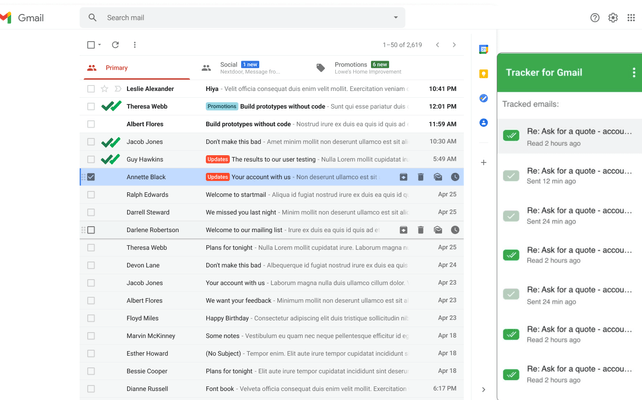





Receive an instant notification as soon as your email is opened
For each tracked email, get a list of all the time it was opened
Your privacy matters: we can’t read your emails. Learn more:
https://mailtrack.email/security
Companies and organizations from all over the world trust Mail Track for Gmail









See what your clients say about us
A cut above the rest of the email tracker for gmail software available. Super easy to use and a generous free plan. Plus, importantly, it doesn't request permission to read my emails.
One of the best email tracking to know when our important emails are opened.
Always know what you will pay
| Free | Premium | |
|---|---|---|
| $0$0 | $2.99$5.99 | |
| / month/ month | / user / month/ user / month | |
| Tracked emails per day | Unlimited | Unlimited |
| Track from mobile | ||
| Mail notifications | ||
| Remove Mail Track Branding | ||
| Real time notifications | ||
| Team Plan | ||
| Get startedGet started | Get startedGet started |
The official 4K remaster fixed some color inaccuracies but retained significant digital sharpening and DNR, leaving a image that often looks more like modern digital video than a 1993 celluloid film.
However, there is a notable quirk. Jurassic Park relied heavily on CGI (computer-generated imagery). Because rendering full-frame CGI in 1993 was too expensive and time-consuming, the visual effects shots were composited and finished only in the 1.85:1 widescreen ratio. Therefore, in a modern fan-made "Superwide" version, the film switches aspect ratios: the live-action scenes (which were shot on film) open up to the full frame, while the CGI-heavy shots (like the Brachiosaurus reveal or the T-Rex attack) remain locked in the theatrical 1.85:1 widescreen, preserving the original visual effects framing.
You must understand that this is not an official product. It is a hand-built labor of love, often stitched together from multiple sources. A single version might combine a 6.5K scan of a 35mm print for the picture, the corrected Cinema DTS track from the CD-ROMs for the audio, and the final episode assembled into a single, pristine MKV file that is often released as the result of years of collective effort. It’s a moving, bleeding-edge art project driven by a shared desire to preserve film history exactly as it was meant to be experienced. jurassic park 35mm 1080p version cinema dts superwide work
This phrase, while seemingly esoteric, describes a specific and highly sought-after fan-created version of the film. It is a restoration project that combines a scan of an original theatrical print, a specific home-video resolution, a classic digital audio format, and an expanded viewing frame. This article will dissect this concept, exploring the technical provenance, historical context, and passionate community that has elevated this version to legendary status.
The foundation of this version’s appeal is the "35mm" source. In an age where films are often scrubbed of grain to appear sleek and digital, the 35mm print retains the organic texture of photochemical filmmaking. Jurassic Park stands at a unique crossroads in cinema history; it was one of the first films to rely heavily on CGI, yet it was shot on film by Dean Cundey, a master of practical lighting. A 35mm scan captures the grain structure, the natural contrast, and the slight imperfections of the physical medium. Unlike the pristine, sometimes plastic-looking 4K UHD releases, the 35mm version retains the "breathing" quality of film. The colors in this version often appear warmer and more naturalistic, lacking the teal-and-orange color grading that dominates modern blockbusters. For the viewer, this is not merely watching a movie; it is witnessing a photochemical artifact, a ghost of the 1993 theatrical run. The official 4K remaster fixed some color inaccuracies
Revisiting the Magic: The 35mm 1080p Cinema Experience of Jurassic Park
Technically, this version is a "grindhouse" style preservation or a "silver screen" restoration. It retains the natural film grain, which acts as a dither for the eyes, making the groundbreaking CGI dinosaurs blend more seamlessly with the practical animatronics. In the 4K UHD retail versions, the extreme clarity can sometimes highlight the seams of 1993 digital compositing; however, the 35mm 1080p scan maintains the atmospheric "glue" of film grain that keeps the illusion alive. Because rendering full-frame CGI in 1993 was too
Disclaimer: This article is for educational and historical discussion regarding film restoration and home theater calibration. The author does not distribute or condone piracy.
Original 35mm prints often possess a richer, warmer color palette compared to modern, sometimes overly sterilized, digital remasters.
Install our free mailtracker now
![[object Object]](https://umsousercontent.com/lib_SOghfaNrOBnPjwdM/xmb70q1hfmzey2nb.png?w=68)