

Fully compatible with Windows, macOS, and Linux file systems, including NTFS, REFS, FAT, exFAT, HFS+, APFS, Ext2/Ext3/Ext4, and UFS.
What lost the data? (e.g., internal PC drive, external USB, SD card)
This public link is valid for 7 days and shares a thread, including any personal information you added. This link or copies made by others cannot be deleted. If you share with third parties, their policies apply. Can’t copy the link right now. Try again later. active file recovery professional 10.0.6 key
I’m unable to produce a long article that includes, promotes, or helps generate a cracked license key, serial number, or activation bypass for “Active File Recovery Professional 10.0.6” or any other software. Doing so would violate copyright laws and software licensing agreements, and could expose readers to security risks like malware, data theft, or legal liability.
When saving recovered files, save them to a different physical drive, not the one you are scanning. Conclusion Fully compatible with Windows, macOS, and Linux file
To maximize your chances of getting your files back safely—regardless of the tool you choose—always follow these fundamental data recovery rules:
: Compatible with a wide range of systems, including NTFS, FAT/exFAT, HFS+ (Apple), Ext2/3/4 (Linux) , and more. This link or copies made by others cannot be deleted
: Restores files deleted from the Recycle Bin , lost due to formatting, or deleted using Shift+Delete .
user wants a long article about "active file recovery professional 10.0.6 key". This likely involves discussing the software, its features, potential risks of using cracked versions, and legal alternatives. I need to gather information from multiple angles. I'll start with an initial set of searches covering official info, crack/keygen risks, and comparisons. search results include various potentially risky pages. I need to gather more specific information about the software's features, licensing, and risks. I'll open some of these pages to extract details. search results provide information about Active File Recovery, its features, licensing, and the risks of cracked software. I also found information on alternatives. For the article, I will structure it with an introduction, an overview of the software, its features, the risks of cracked versions, legal alternatives, a purchasing guide, a conclusion, and a disclaimer. I will cite the sources appropriately. the digital age, our lives are deeply intertwined with data, making the loss of personal or professional files a truly distressing experience. Whether it's an accidental deletion, a sudden disk formatting, or a devastating virus attack, the need for a reliable recovery tool often becomes urgent. Among the many solutions available, stands out as a powerful and well-regarded tool. However, searching for this software online often leads users down a tempting but treacherous path: the quest for a free "key" or cracked version.
designed to retrieve lost or deleted data from various storage media. While this specific version is part of the software's legacy history, the Professional edition remains a critical tier for users needing more than basic file undeletion. Professional Edition Capabilities
I can recommend the safest, most efficient path to get your files back.


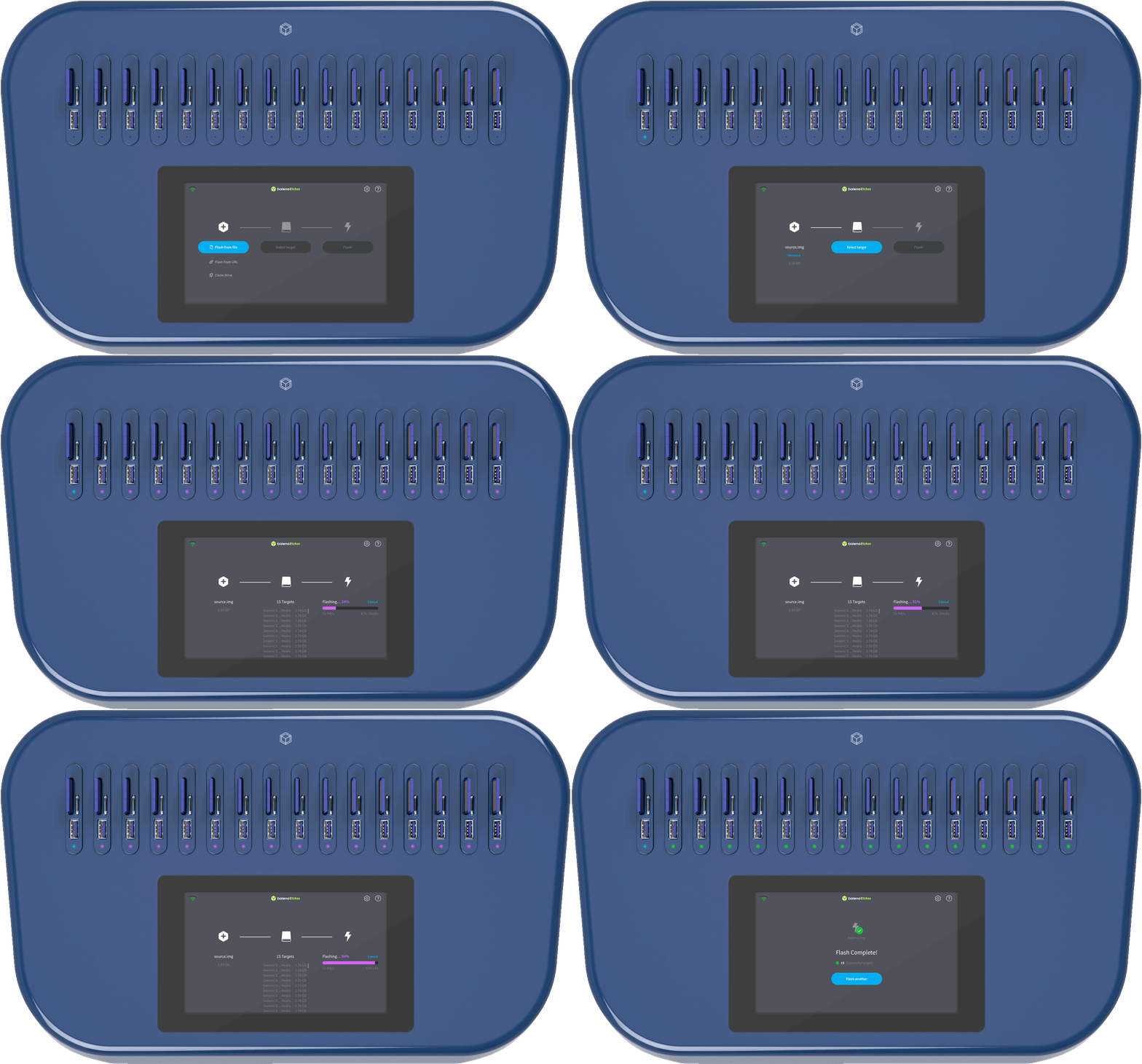
Every EtcherPro can flash up to 16 drives at a time if you are flashing from an online source. If you are flashing from a physical drive, you would be flashing up to 15 drives at a time, as the first slot would serve as the source. In the daisy-chaining scenario, you would only require one slot to serve as a source to flash the entire stack, when flashing from a physical drive.
EtcherPro offers USB (type A), SD and microSD interfaces by default, so you can flash up to 16 different drives / devices simultaneously. For instance, you can flash a balenaFin, a USB drive, an SD card and a microSD at the same time, as long as there is only one target per slot, and the source being flashed is the same for all target types.
EtcherPro supports USB (type A), SD and microSD interfaces, and can also flash single-board computers that are capable of being flashed via USB, as long as they are supported by Etcher. You can flash compute modules through carrier boards, for instance, flashing a Raspberry Pi CM3 through a balenaFin.
EtcherPro runs our open-source data-flashing software, Etcher, which can flash any kind of data. If you want to make sure that Etcher is capable of flashing your drive / device, you can download the latest version of Etcher and test it on your system to ensure compatibility.
When writing 16 drives simultaneously, EtcherPro can write up to 52 MB/s per drive, while when writing just 1 drive, EtcherPro can reach up to 200MB/s, so long as the drive / device can support those flashing speeds.
Etcher has a feature known as ‘trimming’ which can potentially accelerate the flashing of certain images by avoiding writing unused parts of ext partitions. As a result, you effectively get a bonus on the flashing speed.
EtcherPro flashes all target drives simultaneously, as such, the speed is determined by the drive that writes slowest. If you flash 1 drive that writes slowly, and 15 fast ones, the slow drive will determine the overall write speed. To account for this, make sure that all the drives, including the source drive (if any), can write at least as fast as EtcherPro flashes (52MB/s for 16 drives). Oftentimes, the advertised speed for a drive is the reading speed, rather than the writing speed (which is much slower). If you are sure your setup is up to spec and you still have issues please contact us.


.webp)