
Click on one of the physics simulations below... you'll see them animating in real time, and be able to interact with them by dragging objects or changing parameters like gravity.
Portrayed Karan Oberoi. Reviewers felt his role as a sober, introverted character didn't allow him to showcase his full potential. Soundtrack & Legacy
The 2005 film Aashiq Banaya Aapne serves as a quintessential example of the mid-2000s Bollywood "musical thriller," a period defined by bold themes, sleek urban aesthetics, and soundtracks that often outshone the films themselves. Directed by Aditya Datt , the movie is notable for launching the career of Tanushree Dutta and solidifying Emraan Hashmi’s persona as a "serial kisser" in mainstream Hindi cinema. Narrative Structure and Character Dynamics
Persistent, unclosable ads that degrade device performance.
If you search for "Aashiq Banaya Aapne," the primary reason is almost certainly the music. The album marked 's debut as a playback singer, a move that would literally change his career and the sound of Bollywood. The music album was a massive commercial success, selling approximately 2 million units . Here is a list of the standout tracks that still rule playlists today: aashiq banaya aapne movie filmyzilla full
"Aashiq Banaya Aapne" is a light-hearted romantic comedy film that explores themes of friendship and love. While the movie is available on Filmyzilla, I recommend opting for legitimate streaming platforms to avoid any copyright infringement issues. If you're interested in watching the movie, consider exploring alternative options like Amazon Prime Video, YouTube, or Google Play Movies & TV.
Aashiq Banaya Aapne Movie: A Musical Romantic Thriller (2005) – Full Review and Context
Filmyzilla is a notorious piracy website known for leaking movies shortly after their theatrical release, including Bollywood blockbusters and regional cinema. It offers content in various resolutions and formats, making it popular among users seeking free entertainment. Portrayed Karan Oberoi
Aashiq Banaya Aapne is a quintessential 2005 romantic thriller that is worth watching for its nostalgia, music, and dramatic plot twists. While it is easy to find pirated versions, accessing the file is illegal and unsafe. Choose legitimate platforms to enjoy the movie and support the filmmakers.
The film's primary draw was its blockbuster soundtrack, which stormed the music charts and made Himesh Reshammiya a household name. The music not only propelled Reshammiya's career, significantly increasing his fees for future projects, but also helped popularize his distinctive nasal singing style and iconic red cap persona. The hit songs from the film include:
The film revolves around three central characters: Karan (Sonu Sood), a shy and introverted college student who deeply loves his childhood friend Sneha (Tanushree Dutta). However, Karan is too timid to express his feelings. Enter Vicky (Emraan Hashmi), Karan's opposite—a confident, rebellious, and notorious flirt. Directed by Aditya Datt , the movie is
Emraan Hashmi, Sonu Sood, and Tanushree Dutta (her debut role). Romance, Thriller.
The movie features a classic, albeit dramatic, love triangle involving Karan (Emraan Hashmi), Vicky (Sonu Sood), and Sneha (Tanushree Dutta). The story follows two best friends falling for the same girl, leading to a clash of personalities and intense jealousy. Plot Overview (Spoiler-Free)
Aashiq Banaya Aapne (English: You Made Me a Lover ) is a Hindi-language film that marked the directorial debut of Aditya Datt. The film was released on September 2, 2005 , under the banner of Shagun Film Creations. It is inspired by the 2001 American film Tangled .
There are several ways to reproduce a particular experimental setup. The easiest way is to click the "share" button.
When the recipient clicks the URL, the EasyScript that is embedded in the URL will replicate the conditions that you set up.
See Customizing myPhysicsLab Simulations for how to customize further with JavaScript or EasyScript.
myPhysicsLab is provided as open source software under the Apache 2.0 License. Source code is available at https://github.com/myphysicslab/myphysicslab. Online documentation is available.
There are around 50 different simulations in the source code, each of which has an example file which is for development and testing. There are also downloadable versions which be used to show simulations offline (when not connected to the internet).
Most of the simulation web pages show how the math is derived. See for example the Single Spring simulation.
The rigid body physics engine is the most sophisticated simulation shown here. It is capable of replicating all of the other more specialized simulations. The physics engine handles collisions and also calculates contact forces which allow objects to push against each other.
See also links to other physics websites.
The myPhysicsLab simulations do not have units of measurements specified such as meters, kilograms, seconds. The units are dimensionless, they can be interpreted however you want, but they must be consistent within the simulation.
For example if we regard a unit of distance as one meter and a unit of time as one second, then a unit of velocity must be one meter/second.
See the discussion About Units Of Measurement in the myPhysicsLab Documentation.
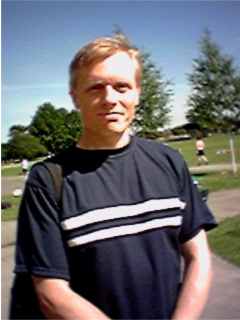
Hi, my name is , I live in Seattle, WA, USA, and I am a self-employed software engineer. I started developing this website in 2001, both as a personal project to learn scientific computing, and with a vision of developing an online science museum. I grew up in Chicago near the Museum of Science and Industry which I loved to visit and learn about science and math.
I got a BA in Mathematics at Oberlin College, Ohio, 1978, and an MBA from Univerity of Chicago, 1984. My first software jobs were using the language APL which I enjoyed for its math-like conciseness and power.
I was fortunate to get involved in the Macintosh software industry early on in 1985, joining MacroMind, which became Macromedia. I led the software development at MacroMind as VP of Engineering for 5 years. Our most significant product was VideoWorks, which was renamed Director, and lives on today as Adobe Director. In the 1980's, the interactive multimedia concepts that are so common today were new and being developed. VideoWorks was mainly an animation tool, but also incorporated programmable interactivity. Our main competitors at that time were HyperCard, SuperCard, and Authorware. Director was used in many different ways; I am most proud that it became the preferred way to prototype software user interfaces for a time during the 90's. Director was also used to develop the introductory "guided tour" tutorial that came with the Macintosh in the early years. And of course, Director was used for all sorts of art, design, and marketing projects.
I went on to work at Apple Computer on new multimedia and user interface concepts involving digital agents, animated user interfaces, speech recognition and distributed information access. In 1991, there was a sudden flurry of activity when Apple and IBM were trying to set up a strategic partnership. I became involved in the super-secret negotiations, and made the suggestion that what the world needed was a standard for multimedia that multimedia content creators could rely on to publish to (ultimately this is what HTML became). Based on these suggestions, Kaleida Labs was founded. Our work there developed a product called ScriptX, which turned out to be very similar to Sun's Java which was being developed at the same time. ScriptX had goals of supporting all forms of multimedia: text, images, audio, video, animation; being cross-platform (Mac and Windows), interpreted, object oriented, with a garbage collector to manage memory.
I then moved to Seattle and turned my attention back to mathematics and science. I relearned calculus by doing all the problems in my old college text book and took further math classes at the University of Washington. I started developing this website as a way to practice what I was learning. I am now happy to use excellent tools such as HTML and JavaScript, and leave their development to others. I continue to work on physics simulations, with several new ones in development.
Archive of older projects.
This web page was first published April 2001.